

11
2026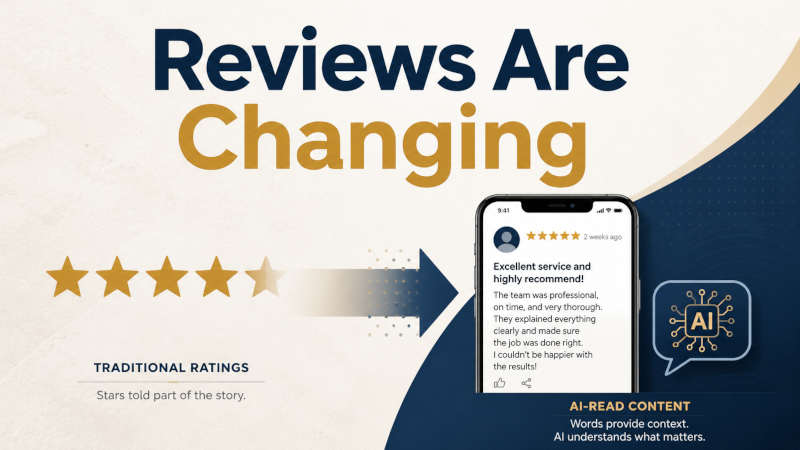
For years, the advice was simple. Get more five star reviews. Keep the average up. Don’t worry too much about the rest.
That advice is now incomplete.
More people in Paso Robles and across the Central Coast are starting to ask ChatGPT, Gemini, and Google’s AI tools who to call, sometimes instead of Google Maps, often alongside it. And those tools aren’t just glancing at a star average. They’re reading the reviews themselves, deciding who sounds trustworthy, and recommending names by, well, name. A thin profile with a perfect rating can lose to a busier one with real detail behind it.
We’ve been working with businesses across this region since 1995, long before Google reviews existed, and we’ve watched review culture change more in the last two years than in the twenty before it. What hasn’t changed is that Central Coast customers, whether they’re in Paso Robles, Templeton, Atascadero, or down toward San Luis Obispo, tend to read reviews the way they’d ask a neighbor for a recommendation. They want the real story, not a polished average.
Here’s what’s actually happening, and what it means for your business.
AI Is a Growing Layer, Not the Whole Picture Yet
It’s worth being straight about where things actually stand. Some of the numbers floating around SEO blogs this year make it sound like AI has already taken over local search. For a search like “plumber in Paso Robles,” that’s not really true yet. Research from Whitespark, one of the more careful local SEO research groups, found no reliable pattern between how often the map pack shows up on local queries and how often an AI generated answer shows up instead. For direct, need it now searches like a plumber or electrician nearby, the map pack, the same three listings pulled from Google Business Profile, still does most of the work.
What has grown is consumer willingness to ask an AI tool the same kind of question they used to type straight into Google. More people are experimenting with ChatGPT or Gemini as one of several places they check before calling someone, especially for research heavy decisions. That’s a real shift worth preparing for, it’s just not yet the dominant path for an emergency plumbing call the way some headlines suggest. The businesses that get ahead of it now won’t be scrambling to catch up once it is.
Either way, the review profile behind your business is doing double duty. It’s still what a human reads before calling. And it’s increasingly what an AI tool reads before recommending you by name.
The Star Rating Bar Keeps Rising
Consumer patience for anything less than excellent has thinned out. Recent survey data shows 31 percent of consumers now only consider businesses rated 4.5 stars or higher, nearly double the share who said that a year earlier. Sixty eight percent won’t consider anything under 4 stars at all. A rating that felt perfectly fine two years ago can now get a business filtered out before a person ever sees the listing.
That part isn’t new information exactly, most business owners already sense the bar is higher than it used to be. What’s newer, and more useful, is understanding that the rating itself is only half of what AI is actually evaluating.
AI Doesn’t Just Count Stars, It Reads the Reviews
This is the part that changes the strategy. Research on how AI search engines use reviews found ChatGPT references review content directly in over half of its local business responses, and Perplexity does so in nearly all of them. These tools are reading sentiment, specific phrases, recency, and consistency across platforms, not just averaging star counts.
Practically, that means a business with 80 detailed, recent reviews that mention specific jobs, specific neighborhoods, and specific outcomes will often beat a business with 200 generic five star ratings that all say some version of “great service.” The shallow reviews don’t give an AI model anything to work with. The detailed ones do.
For a plumber, that might be a review mentioning a same day water heater repair in Templeton. For a concrete contractor, a review describing a driveway pour that held up through a wet winter. For a dentist, a review about how the front desk handled an insurance question. Specifics are what get quoted back.
Don’t Keep All Your Reviews in One Basket
Google is still the main event, most consumers check Google reviews before anything else, and that isn’t changing anytime soon. But putting every review on a single platform is starting to look risky. Google alone now hosts a slightly smaller share of all reviews than it did a year ago, as more consumers spread their research across Yelp, Facebook, and industry specific sites. Yelp reviews in particular tend to run longer and more detailed than Google reviews, which is exactly the kind of specific, story driven content AI tools look for.
None of this means chasing reviews on five platforms at once. It means not ignoring the one or two beyond Google that already show up when someone searches your business name, usually Yelp and Facebook for most local service businesses, and making sure those are current instead of abandoned.
Responding to Reviews Is No Longer Optional
Here’s a number worth sitting with. Nearly 90 percent of consumers now expect a business to respond to its reviews, and roughly one in five expect that response the same day. That expectation has more than tripled in a year.
Responding does two things at once. It reassures the next customer reading that review before they call. And it adds fresh, specific, first party content to your profile, the exact kind of material AI tools weigh when deciding who’s active, credible, and worth recommending. A business that responds consistently is telling both humans and machines the same thing: someone is actually paying attention here.
A stale profile with old reviews and no responses doesn’t just rank lower. It becomes close to invisible to the tools an increasing share of your future customers are starting with.
Case Study: Turning a Negative Review Into a Repeat Customer
One of our clients, a local home service company in Paso Robles, once received a negative review that included a few claims that simply weren’t true. The client’s first instinct was understandable, fire back, set the record straight, defend the business publicly. We talked them out of it.
Instead, we helped them write a calm, professional response. No accusations, no defensiveness, just a clear and respectful correction of the facts along with an invitation to talk it through directly. That tone did more work than an argument ever could have.
The reviewer noticed. Not long after, that same person ended up hiring the client for another job. By the time the work wrapped up, the reviewer had gone back and removed the original negative review entirely.
It’s about as good an outcome as a negative review can have, and it didn’t happen by accident. It happened because the response was handled the way a business that’s been part of this community for decades knows how to handle it, with patience, not panic.
What This Actually Means for a Central Coast Business
None of this means chasing a perfect rating or panicking over one bad review. It means shifting the goal from “get more five stars” to “build a review profile with real depth.”
A few things that move the needle:
- Respond to every review, good and bad, and respond with specifics, not a copy paste line.
- Ask happy customers for reviews that mention what was actually done, not just how it went.
- Keep review activity recent. A profile that hasn’t had a new review in months reads as inactive to both people and AI tools.
- Make sure your business information matches everywhere it appears, your website, your Google Business Profile, and any directory or platform your reviews live on. Inconsistency undercuts the confidence AI needs to recommend you by name.
Where Access Publishing Fits In
Review response management has been part of our Local SEO and GEO work for a long time, mostly because it’s one of those tasks every business owner knows matters and almost nobody has time to do well. We’ve been part of this community since 1995, and we write and manage responses for clients across the Central Coast, keep profiles active and current, and make sure the details are consistent everywhere they need to be.
Knowing the area matters more than people expect. A response that reads as genuine in Paso Robles or Templeton sounds different than boilerplate customer service copy written for a national brand, and Central Coast customers can tell the difference. That local familiarity is part of what makes the responses work, not just for the person reading them, but for the AI tools increasingly reading them too.
Worth noting: ranking well in Google’s map pack doesn’t automatically mean an AI tool will recommend the same business. The two are related but not the same job anymore, a business can rank first locally and still get skipped by an AI generated answer, or the other way around. An active, detailed, responded to review profile is one of the few things that genuinely helps with both at once, which is exactly why it’s worth the effort regardless of which channel a given customer starts from.
Frequently Asked Questions
Yes. A thoughtful, specific response to a negative review often builds more trust than another generic five star review would, both for the next customer reading it and for AI tools weighing how engaged a business is.
There’s no magic number, but recent survey data shows a meaningful share of consumers won’t consider a business with too few reviews at all. Depth and consistency over time matter more than hitting one specific count.
It’s worth paying attention to, since a growing share of consumers filter at that threshold. But a 4.3 or 4.4 average with detailed, recent, well answered reviews can still perform better in AI search than a higher average with thin, generic ones.
It’s part of the same program, not a separate one. GBP ranking and AI visibility don’t always move together, but review strategy is one of the few pieces that supports both, so it makes sense to manage it alongside your GBP work rather than as an afterthought.
Let’s Look at Your Review Profile
If you’re not sure what your reviews are actually telling AI tools and future customers about your business, we’re happy to take a look. Call us at (805) 226-9890, reach out through our contact page, or request a quote online. We’re right here in Paso Robles, and this is the kind of work we do every day.